FRONDS report #1
My first update! If you'd rather listen, click here.
Warning: This is a long one! They won’t all be this long, I promise.
At the time of writing, it’s been almost two months since I first discovered that FRONDS - phase one of a larger investigation into palm trees in the UK - was being supported by Creative Scotland's Open Fund for Individuals. It's slightly mind-blowing that it's been that long already, and even posting this update has taken me two weeks, three complete revisions, and today alone, an entire packet of choco leibniz biscuits. But I'm over the moon to be here, so lucky to have this opportunity, and trying hard not to let palms take over my every waking moment.
Anticipating that a key strand of this work will be a return to writing, I foresee regular written FRONDS reports as part of that, the first of which you are now perusing. I hope it gets easier. I love writing; in the right mood it can pour out of me with no effort whatsoever, but I find editing a painful process, even if it is an essential one. Eventually though, FRONDS will inform production of what I hope will be a publication down the line, featuring words and pictures from a range of contributors. And as a thread running through this initial phase, I know it’s essential that I write informally throughout, to practice that editing process, and so a narrative can begin to take shape. So, welcome!
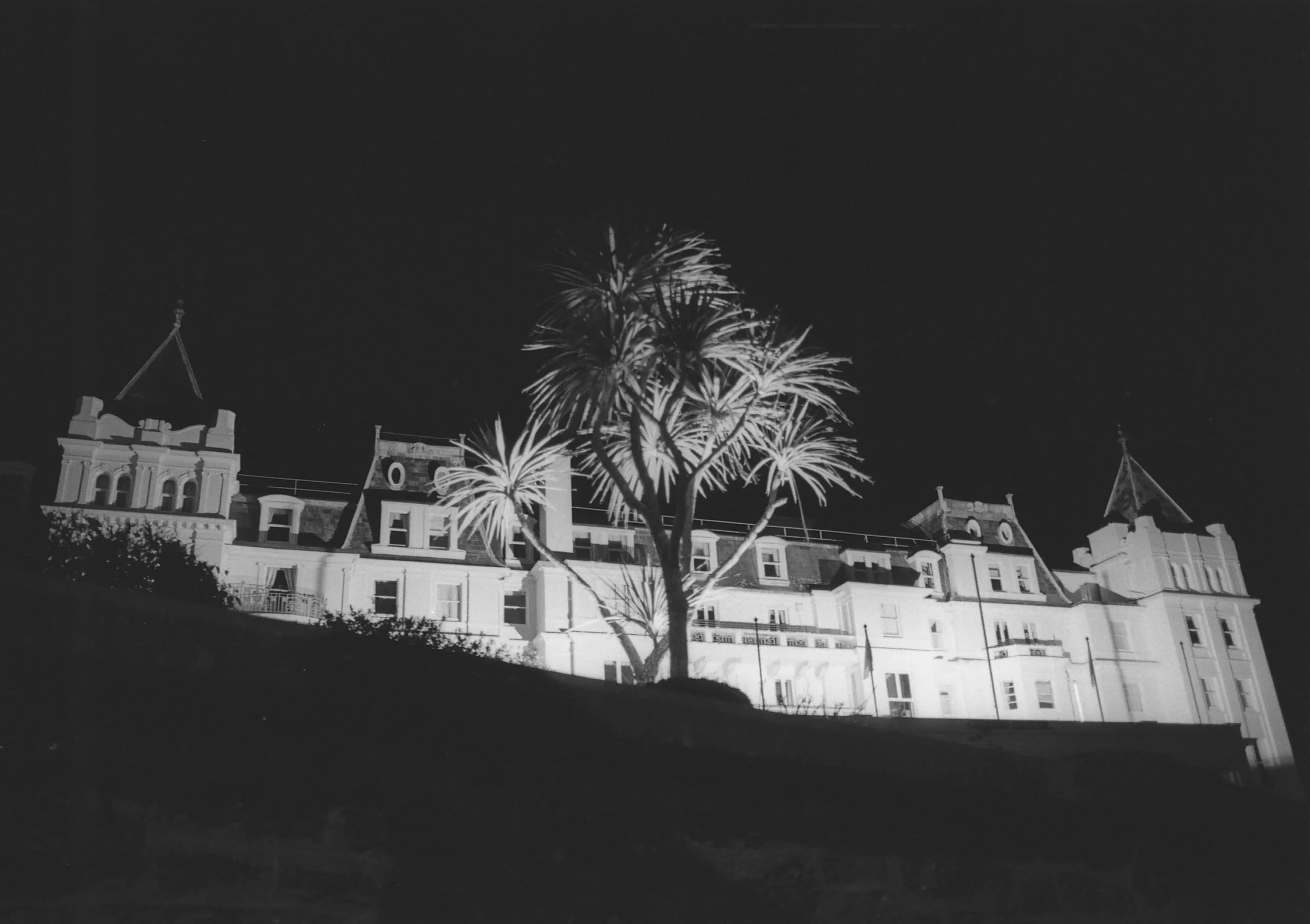
Image: Cordyline australis, The Grand Hotel - Torquay (2019, credit: CW)
A question you may be wondering is ‘why palms?’ and perhaps that’s a good place to start building some context. The image you see on the left is a ‘Torbay palm’, one of a series of photographs taken in early 2019, whilst staying with my parents in Paignton and trying to re-route my career. This may sound a bit fancier than it was - it was me living in their attic and working on the breakfast buffet at Travelodge, applying for every creative industries job in the UK. But whilst temporarily back in Torbay for the first time since I was 18, the palms struck me. It was really the first time I'd noticed them everywhere; I’d been in Scotland long enough for my hometown to now appear somehow other.
Palm trees are everywhere across the UK, but in Torbay, for those who haven’t been, I really mean everywhere. I didn't, and still don't, yet, know a great deal about Torbay’s history and had always assumed growing up that the palms and monkey puzzles populating parks and people’s front gardens were native English plants. An easy assumption for me in my ignorance, and a foolish one to anyone who knows anything about plants or British history. Had you asked me my favourite Devonshire tree, until embarrassingly recently I would have said the 'Torbay palm'. Learning these were all imports, re-named, taken from overseas, created a bit of a fixation for me.
So that was the start in 2019. And lately I’ve been finding myself thinking again about these ideas, coming back to themes of landscape, identity, belonging, migration, and place. What does it mean to be ‘from somewhere’? How long does something have to exist in a place before it becomes ’part of the landscape’? This first phase includes three strands of photo work, and three strands of broader research (botanical, archival, chemical). I will be working with my friend and collaborator Zoe Hamill on the chemical work, using palm specimens to test and compare new recipes for plant-based developers.
My three focus species at the start of this work are: Cordyline australis (for reasons that should now be evident), Phoenix canariensis (because of the Torquay roundabout controversy from 2012), and the Sabal palm (inspired by RBGE’s 200-year old tree, recently felled and found to have been masquerading under a false identity all that time). So there, that’s the most concise way I can think of to tell the origin story of this work. We’ll learn more about the six new strands of enquiry as we continue.
So what have I been doing this first six weeks? And what have I learned thus far?
Largely, this first stretch has been about setting wheels in motion, writing lots of emails, reading, looking back at all the photographs taken at the start of this work, and properly actioning the routes forward for both the research processes and image-making. I should stress that FRONDS isn’t being done full-time, but roughly one day per week. Regrettably, there’s not been a huge amount of photo-taking or making thus far (that I can share here at least), and in honesty that’s starting to tug on my creative brain, like a toddler becoming increasingly impatient.
Probably my first big discovery (which happened mere weeks after submitting my CS application) was that Cordyline australis, the ‘Torbay palm’, ‘cabbage palm’, or to the Maori people, Ti, is not actually a palm at all. Well. That was a bit of a shocker! Of course its formal classification doesn’t strictly matter to me - one of the perks of being an artist and not a real scientific researcher - but how interesting, another example of something I had assumed, and another assumption proved incorrect.
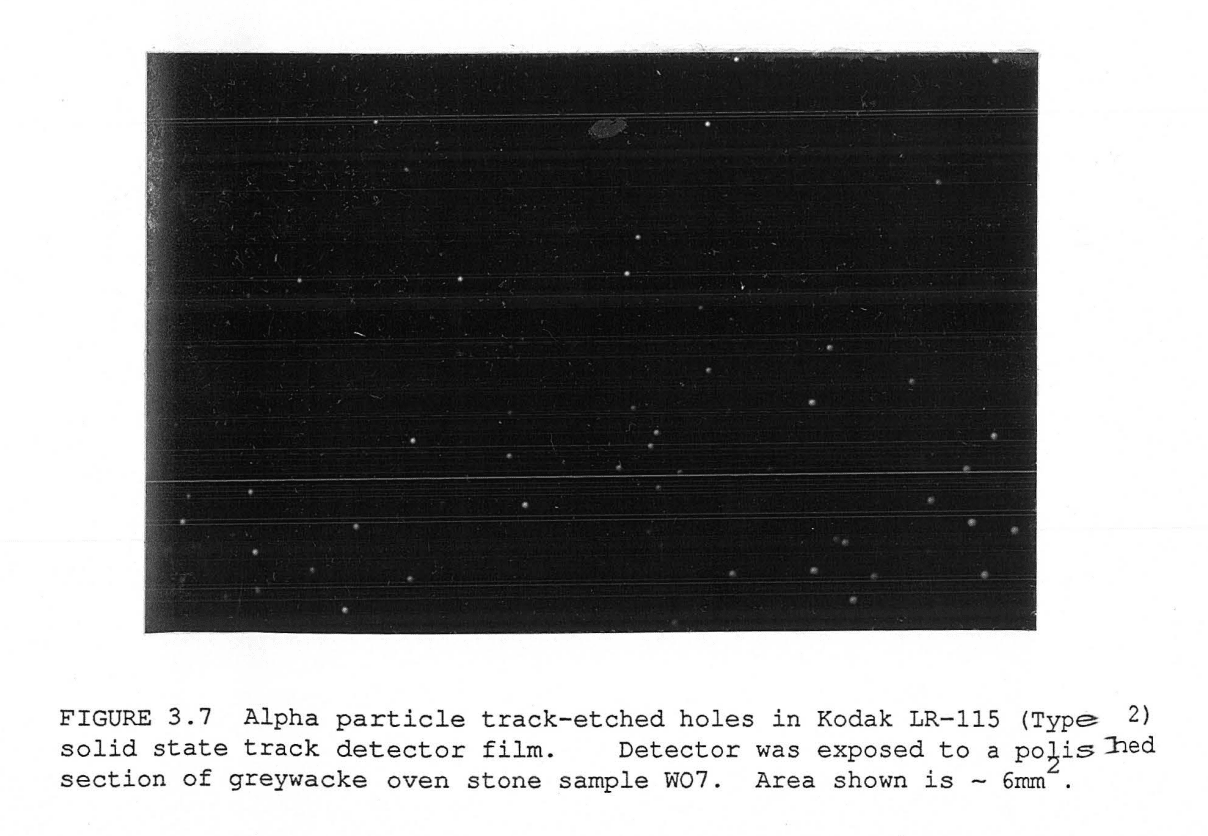
Image: excerpt from ‘Archaemetric Studies of Cordyline’ - nope, not computing
Currently this is the plant I’ve learnt the most about, and certainly the one I’ve photographed the most. I’m working my way through the formidable 200-page thesis Archaeometric Studies of Cordyline (Ti) Based on Ethnobotanical and Archaeological Research (1986) by Barry Fankenhauser. This details Māori cultivation of the plant, with observations and calculations that hover just on the cusp of my scientific understanding. Carbon dating? I’ve heard of that, I can kinda figure it out. Much of it, I really can’t begin to comprehend.
A shorthand version of what I’ve read thus far is essentially that Cordyline australis (Ti) was cultivated as a crop, the large roots were cooked in enormous underground ovens and then pulped into a kind of jam used to sweeten all kinds of other edible plant bits. I don’t think this particular discovery has anything at all to do with the proliferation of Cordyline australis across Torbay, the West Country, or indeed the wider UK but it’s interesting nonetheless. There’s also a great deal of information about the specific chemical make-up of a variety of Cordyline species, which may or may not be useful for Zoe’s chemistry recipes. We’ll see.
This process of learning before shooting is new, and I’m trying to become more comfortable with the slower progress necessary to work this way. It’s both a thrill and a challenge to see something and try to sort through it all, learn everything I can gather. Instead of just heading out and pointing a camera, I'm trying to point my brain a bit. Tangentially, I don't think it's a coincidence that the more time I spend lingering in online social media spaces, the more difficult I find it to focus my attention and think critically. And in many ways this is part of the motivation behind FRONDS too - to re-learn how to investigate something, to write about something, and to remember what it's like to develop ideas and change/challenge perspectives.
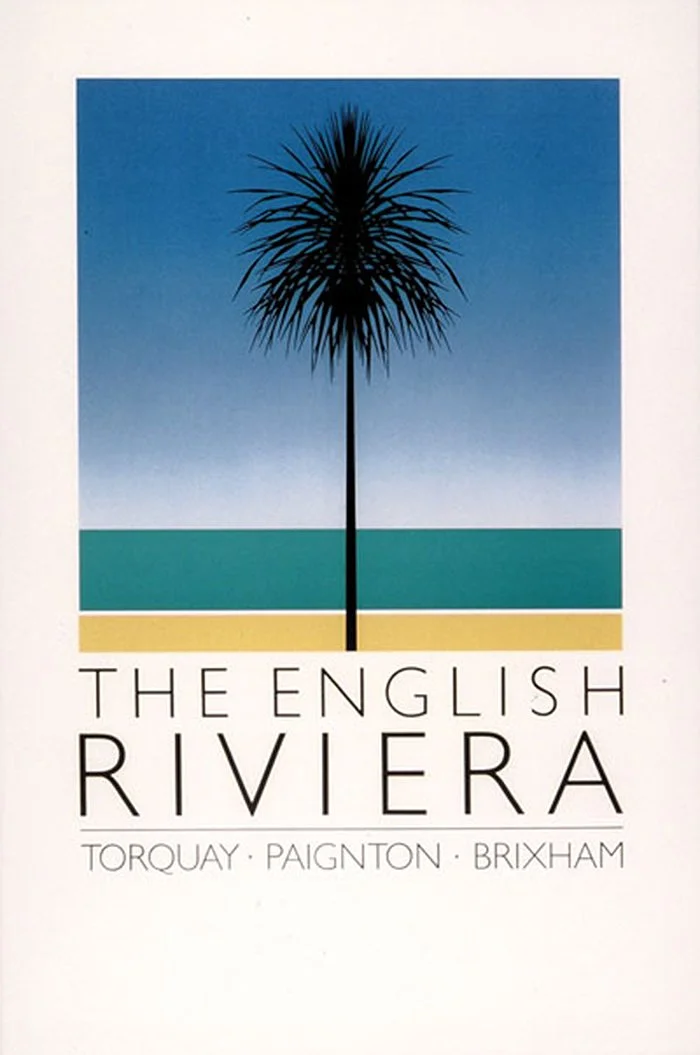
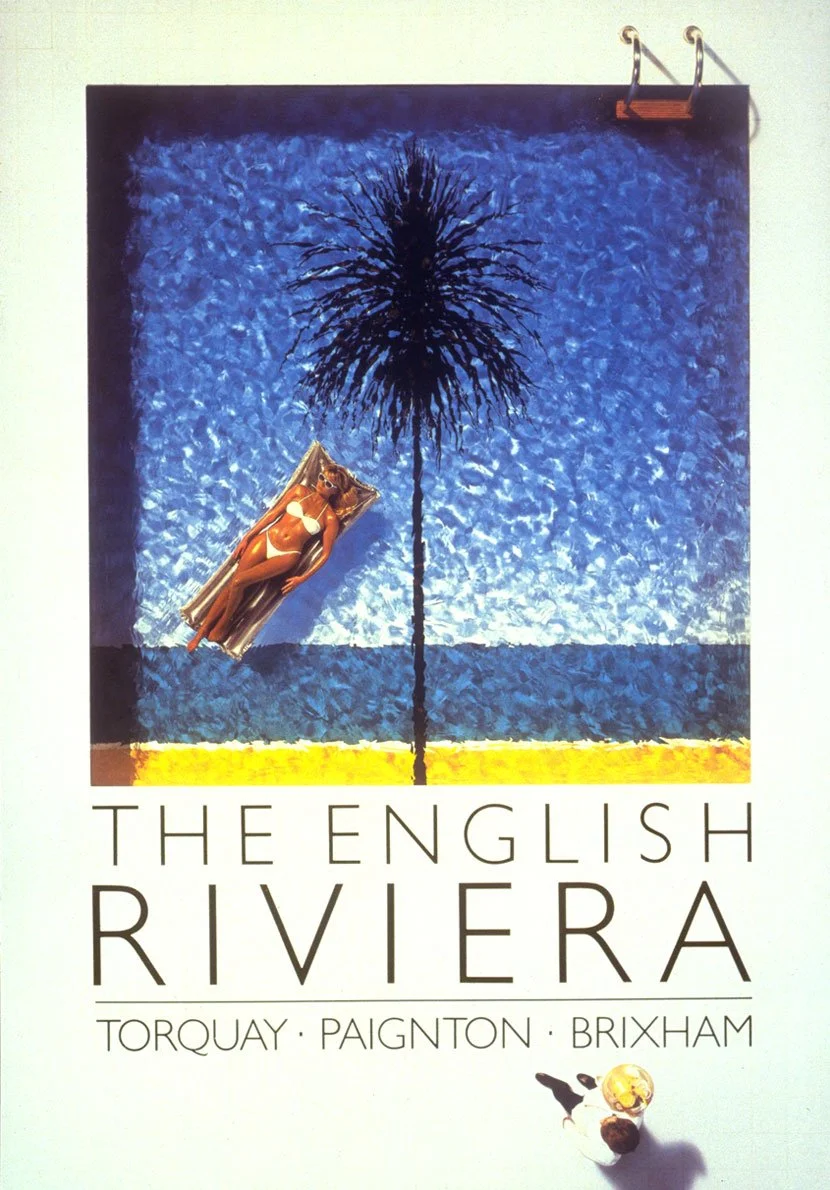
So, what else have I been reading about in this slower process? Admittedly, I went down a rabbit hole looking into the phrase ‘English Riviera’ and revisiting the use of palms as a modern marketing vehicle for Torbay. I wanted to revisit this iconic poster by John Gorham (left, 1982) which has been ‘riffed upon’ in various instances since (right, David Hughes, 1986) - including by popular band Metronomy, who named their first album as such. I remember their hit ‘The Bay’ (in particular its music video) making me grind my teeth at the time, as the bay represented was not the one I had grown up with at all. Torbay is a complex place, and it’s much more than a destination during summer. 2025 Indices of Deprivation data shows my hometown (Paignton) in the most-deprived percentile of the population, alongside large swathes of central Torquay. Sure, some bits absolutely cater for the uber wealthy: manicured lawns, yachts, villas on cliffs. But something about those women waving their legs around in that video irritated me. Perhaps it was just a way to sell a hit. Either way, these English Riviera poster designs and the elegant palms central to them do make me think of home; they have seeped into my subconscious, and the Cordyline is doing a lot of iconographic work.
I guess part of what I’m asking in all this is what is this symbol doing here? What does it do to a sense of cultural identity when your very sense of ‘place’ is nicked from the other side of world? Anything? Nothing?
In other news, my 35mm cameras are out of hibernation and I’m shooting urban palms and cordylines across Scotland. The joy of seeing spiky fronds peeking out of tenement gardens as you round a corner is honestly unmatched. And perhaps most excitingly, and the thing that’s taken the most planning, I’ve booked my main research visit down South this month, and will visit London, Kew Gardens, Oxford Botanical Gardens, Torquay Museum, and hopefully many more interesting spots, as well as reaching out to try and source companion palm nerds who will happily share their knowledge. In fact, that’s another discovery: the European Palm Society. Wowee. A whole forum on ‘unexpected urban palms’, and one user has made a comprehensive interactive ‘London and UK palm map’ with species-labelled pins. What an absolute dream. It really goes to show that any time you think you’re the only person weirdly interested in something, you’re absolutely not.
I have yet to dig into the palm forums too deeply, but it’s exciting to unearth this group of palm fanatics, and having seen how happily they share pictures of their beloved trees, I imagine it will be easier than expected to encourage folks to pose for formal portraits. Fingers crossed! Watch this space!
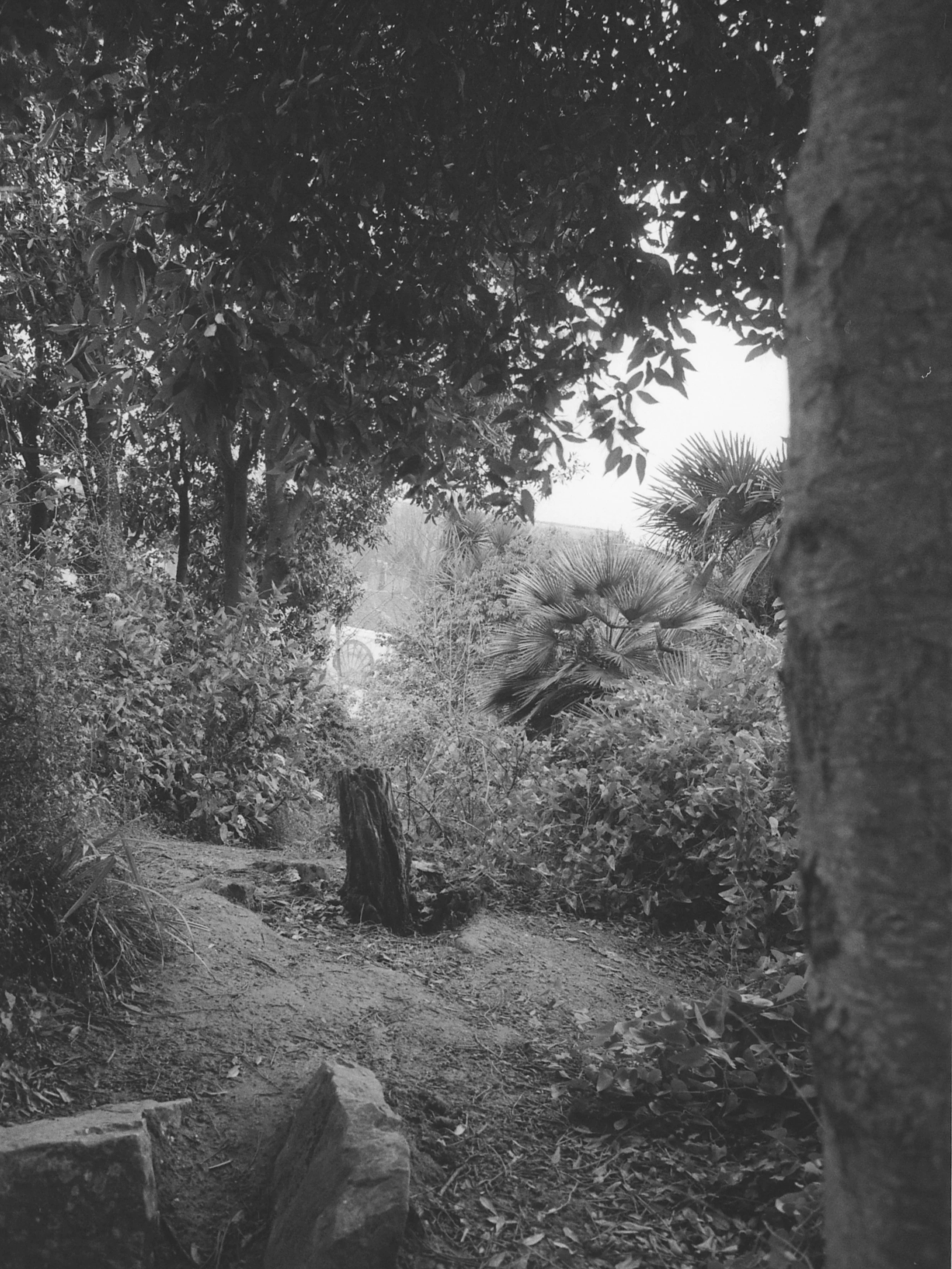
Image: Trachycarpus fortunei (?) with Shell Garage in distance - Paignton (2019, credit: CW)
Last month, it was a pleasure to meet Simon Allan, Senior Horticulturist (glasshouse department) at Royal Botanic Garden Edinburgh, where we discussed the project in all its sprawling potential and I was informed that no, sadly I cannot take bits of palms out of the gardens to cook into developer. I guess that makes sense. We discussed Karine Polwart’s Windblown, the Cordyline’s sneaky non-palm status, as well as the approaching re-opening of the glasshouses in October this year.
As a Scorpio, I am choosing to receive this as a birthday gift from the universe, and can’t wait to get in and spend some time with my presents (the plants).
We also spoke about the collections at RBGE, and I attempted to comprehend what was stored in the herbarium and how it all worked. Learning about the various methodologies and storage facilities and research avenues has been a little bewildering, I admit. It’s easy to streamline how we find things out these days to Google and Google alone, it’s a reminder of how much else exists.
I will try and access any photographic records in due course, and Simon also tempted me to add a fourth palm to my research list: Trachycarpus fortunei.
Turns out I’m a palm sucker and after looking longingly at the two situated down by the John Hope Gateway, plus their distant cousins dotted all over Princes St gardens later that day, I relented and now have a handsome plant in a pot at home (non-toxic for cats)! Now, as is the way, I seem to spot them everywhere I go, including in my own snapshots of urban palms from 2019.
So, Trachycarpus fortunei looks like it might be an addition to my Species Of Interest list… partly because it’s a fan palm, partly because it’s been so heavily domesticated across the Western world both outdoors and as an indoor pot plant, and partly because after speaking to Simon I realised the Sabal palm may be tricky to work with due to its rarity and general difficulty with access. So whether there will be three or four species in my final considerations, time will tell. The more the merrier, I’m tempted to say.
Ok, I should probably wrap up now. That feels like it’s been way too much and way too little at the same time, but hopefully gives a glimpse into my interests and explorations thus far. I know I’m a wordy writer and I’m trying hard not to view this thought space as something that needs to be too heavily curated - lest I never actually press post at all - but it’s probably not wise to spend any more hours trying to whittle this further. Fortunately, this first whack of writing has just about matched the duration of my caffeine-buyoed ascent, but now we’re circling crash territory. Chasing the caffeine high is a dangerous game, so I’ll be back with more things soon. In the next update I’ll have fresh photos, loads more learning to unpack, and may even be writing from a moving train carriage… Oh, the romance!
Until next time,
CW